From the family conversation to the last breath, in one place
Discontinuing ventilator support is one of the most meaningful things an ICU team does, and one of the least standardized. This course covers the ethics, the conversation, the procedure and the aftercare, so the whole team works from the same plan.
Every module ends with knowledge checks, and the course closes with a 15-question post-test and an evaluation form.
Critical care nurses, nurse practitioners, physicians, respiratory therapists and nursing education departments.
What the course covers
Foundations
The ethical and legal footing, and what the evidence shows about comfort medication and survival.
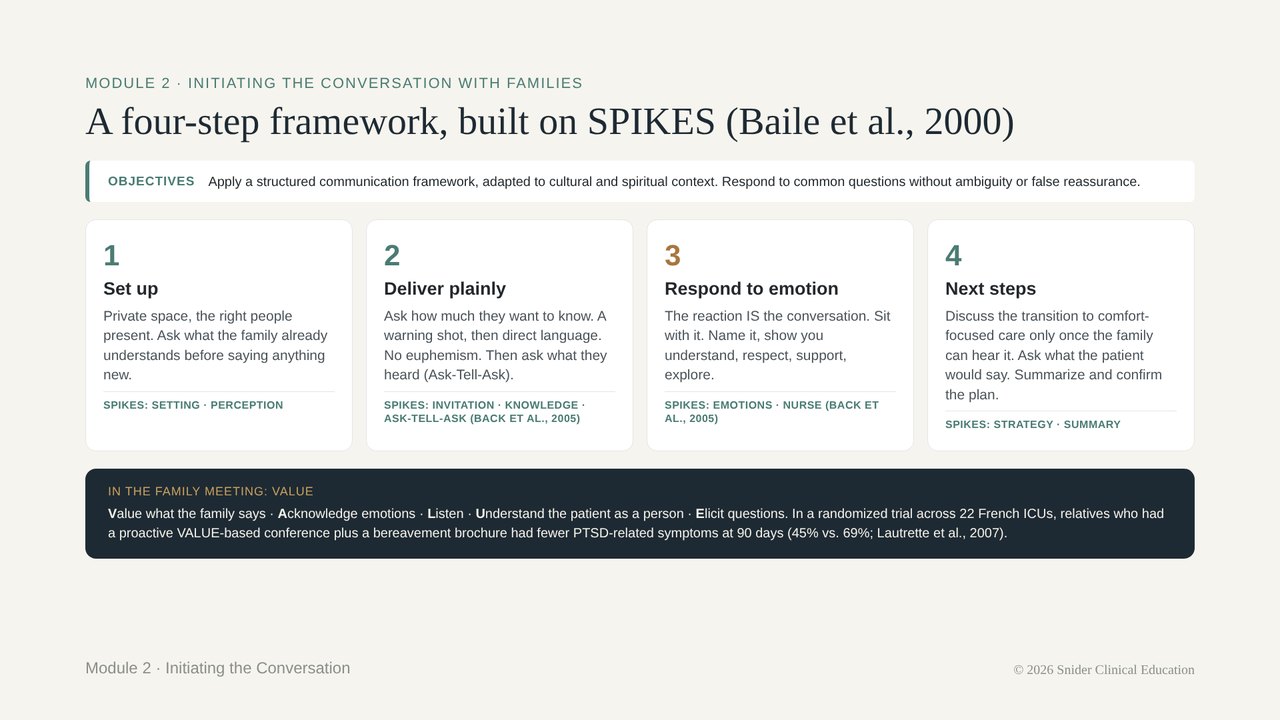
Initiating the conversation with families
A structured framework for the family meeting, with plain language for the questions families ask.
Preparing for comfort-focused care
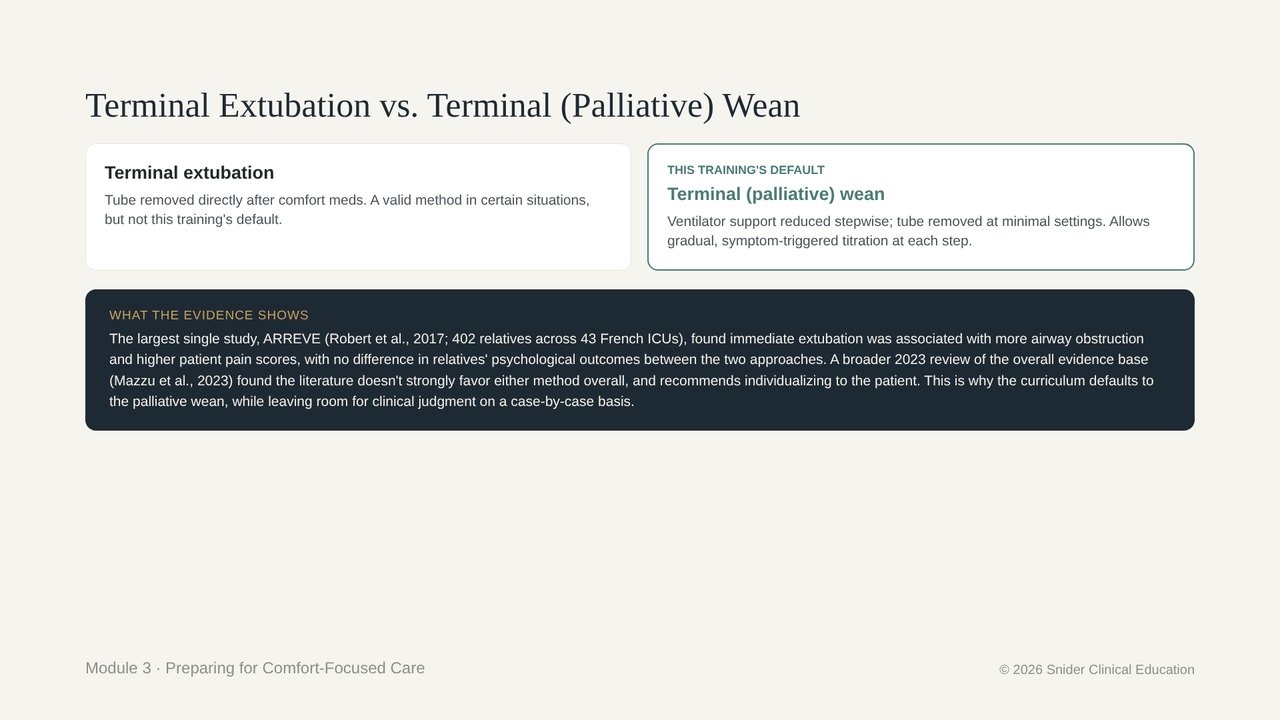
Clinical preparation, medication strategy, and choosing between terminal extubation and a terminal wean.
The comfort-focused care process and active dying
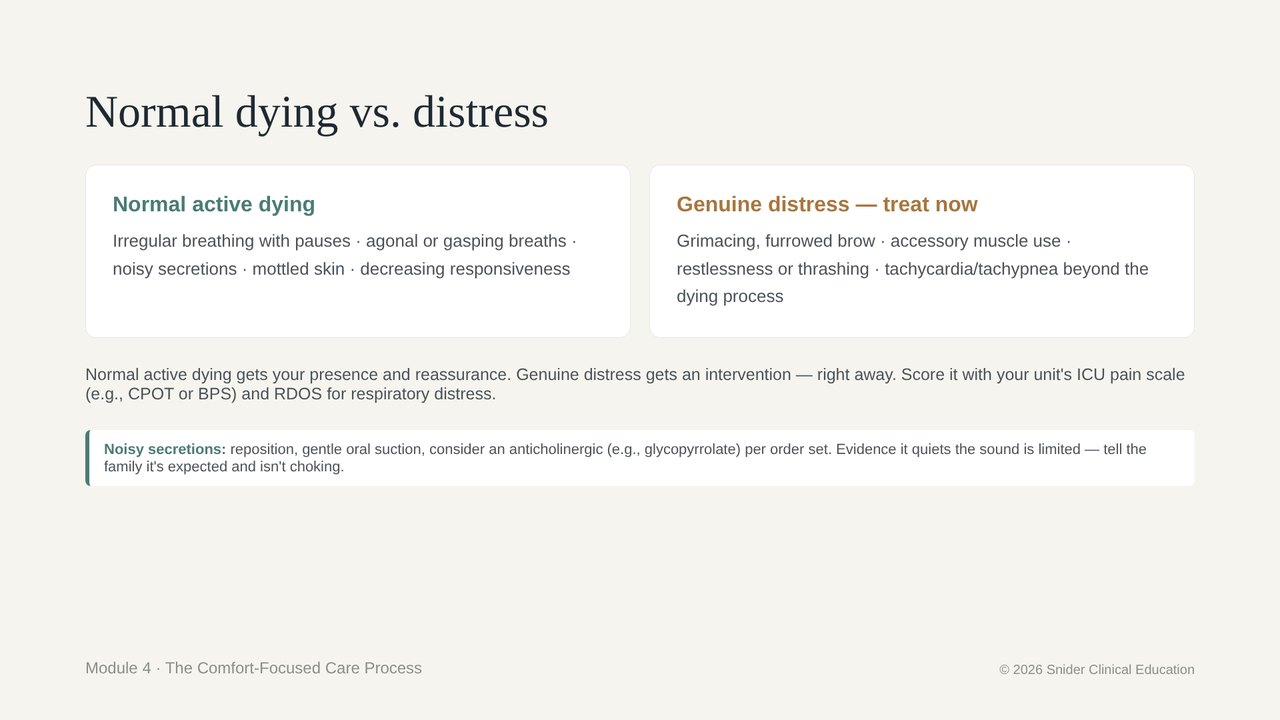
A stepwise, symptom-triggered wean, titration to distress, and what normal dying looks like.
After death: family and staff support
Supporting the family in the moments after death, keepsakes, and caring for the team.
Sample slides from the course
Every module is narrated and built on cited evidence. Here are three slides as your learners will see them.
Ready to use in your learning system
- The narrated course as a video file you can upload to your own learning management system.
- A two-page bedside weaning protocol your team can use at the bedside.
- A 15-question post-test and an evaluation form.
- An instructor answer key.
Your institution certifies its own credit
Continuing education credit, if offered, is awarded and certified by the organization providing the course to its learners. That organization also sets any contact hours and expiration date.
Licensing is available to hospitals, health systems and education providers. Tell me about your setting and I'll send details.
Contact BrandonFrequently asked questions
Who is the course for?
Critical care nurses, nurse practitioners, physicians, respiratory therapists and nursing education departments. It is written for the ICU team that cares for a patient and family at the end of life.
Is continuing education credit included?
No. Credit is awarded and certified by the organization providing the course to its learners. That organization also sets any contact hours and expiration date. The post-test and evaluation form are included to support that process.
What file formats do we receive?
The narrated course comes as a video file of about 40 minutes, with no pauses, that you can upload to your own learning management system. The bedside protocol, post-test, evaluation form and instructor answer key are provided as documents.
Does the course cite its sources?
Yes. Modules 1 to 4 each include a references slide with full citations, so your educators and committees can see where the content comes from.
Can we adapt the protocol to our order sets?
The protocol is a general guideline and is meant to be adapted. Orders and medications should always follow your institution's order sets and the individual patient. If you want to discuss adapting the course materials, mention it when you get in touch.
How do I license the course?
Email [email protected] with your organization and a rough number of learners. I'll reply with licensing details.
Brandon Snider, MSN, ACNPC-AG
Brandon has spent more than 20 years in the ICU. He began in 2004 as a patient care technician in a Level 1 surgical trauma neurosurgical ICU, became a nurse in 2007, and went on to care for patients at the bedside in surgical trauma neurosurgical, medical-surgical and neuroscience ICUs. He has practiced as a nurse practitioner in a neuroscience ICU since 2017.
He holds ELNEC certification and precepts NP students and fellows. He created this course after seeing how much a clear plan and a shared language help families, nurses and providers through the end of a life.
This course is for education only. It is a general guideline, not a substitute for clinical judgment or your institution's policies. Adapt all orders and medications to your institution's order sets and to the patient.